Issues of Aging Infrastructure and Potential Solutions - A PIARC Briefing Note
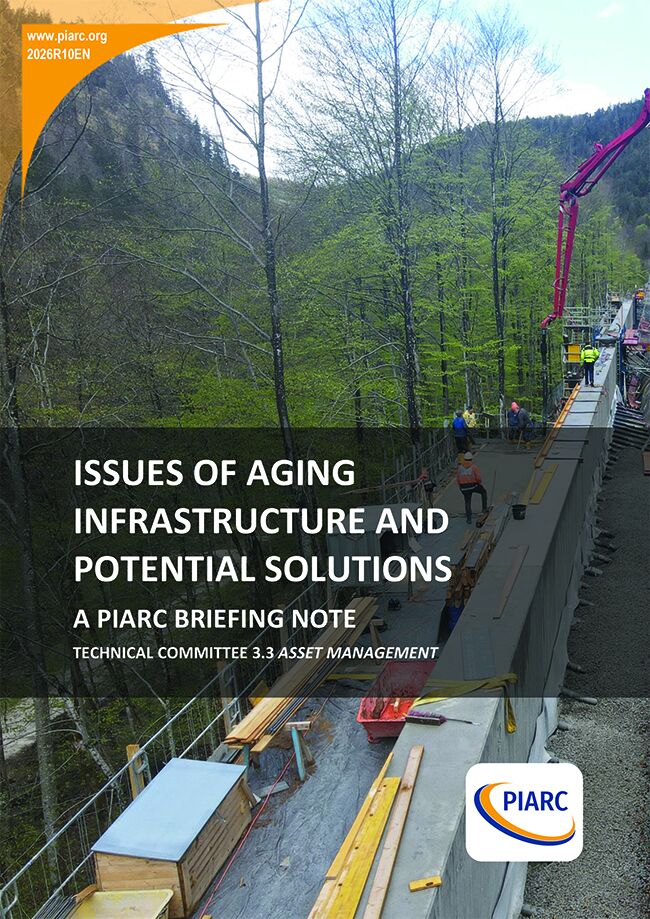
Aging road infrastructure is a global challenge affecting safety, performance, and cost efficiency across all countries. This briefing note focuses on some of the principal asset types that make up road infrastructure (pavements, bridges, safety barriers, earthworks, and lighting), reflecting their critical role in network performance, safety, and overall asset value.
Aging assets are defined as those that no longer meet required service levels due to deterioration, changing demands, environmental pressures, or insufficient maintenance. These challenges are intensified by climate change, increasing traffic, and constrained funding. Common issues include physical deterioration of assets, outdated standards, and environmental impacts.
In response, PIARC has established a working group to focus on the issues of renewal and rejuvenation of aging infrastructure, which published a technical report in the 2020-2023 cycle. For the subsequent 2024-2027 cycle, the working group is developing a series of briefing notes, with this document providing asset-specific examples of issues related to aging infrastructure, along with case studies of solutions from international road administrations:
- Argentina - Use of Sand-Asphalt SAMI membranes to mitigate reflective cracking and extend pavement life.
- UK - Predictive modelling to manage concrete compression failures in pavements driven by rising temperatures.
- Switzerland - Portfolio‑level seismic assessment to identify and prioritise vulnerable bridges under modern seismic codes.
- Germany - Using a bridge scheduled for demolition to test and refine monitoring and assessment techniques.
- Slovenia - Network‑wide prioritisation and integrated renewal strategy aligning barrier upgrades with pavement interventions.
- Bolivia - Comparison of reinforced concrete retaining walls vs. geosynthetics for slope stabilisation in highly vulnerable urban terrain.
- Belgium - 20‑year public-private partnership to renew entire regional lighting network, installing 110,000 smart LED lights and modernising control systems.
The briefing note provides a series of recommendations, both for practitioners (establish specific standards for existing infrastructure, enhance condition monitoring and compliance, adopt predictive maintenance, develop clear maintenance strategies, consider organisational resilience and subsequent briefing notes), plus PIARC itself (possible development of further case studies and potential future cross TC-collaboration within Strategic Theme 4 – Resilient Infrastructure)
Information sheet
- Date: 2026
- Author(s): Comité technique / Technical Committee / Comité Técnico 2024-2027 3.3 Gestion du patrimoine routier / Asset Management / Gestión de activos
- Domain(s): Road Assets Management
- Type: 2026R10EN - A PIARC Briefing Note
- PIARC Ref.: 2026R10EN
- ISBN: 978-2-84060-859-2
- Number of pages: 35